
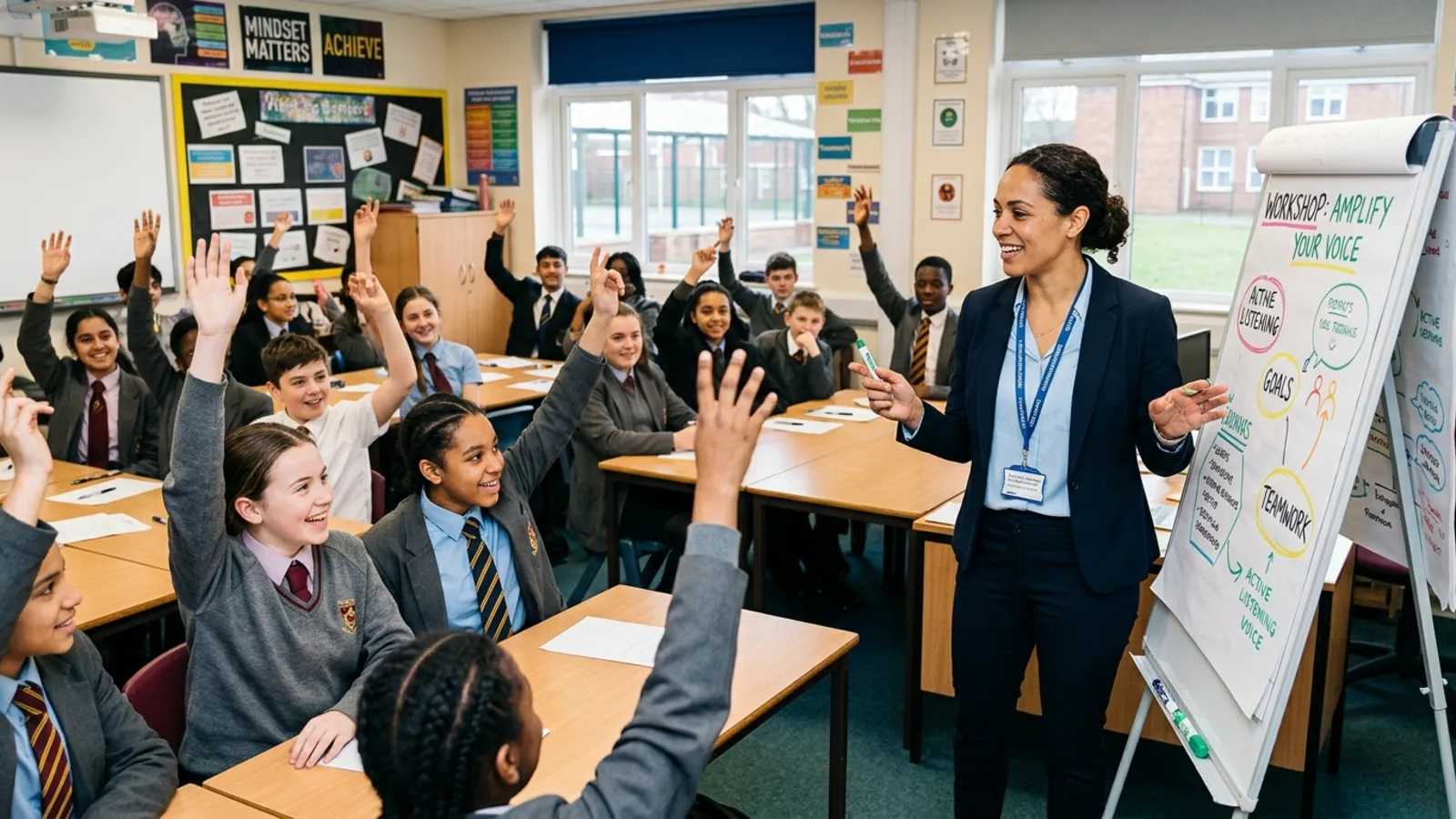
Working with schools requires a different mindset from working with private coaching clients. When I run a school coaching programme Birmingham pastoral teams contact me about, I am stepping into an environment that already has its own safeguarding structures, referral pathways, and pastoral hierarchies. My role is to work within those frameworks, not around them. This page is written for pastoral leads, SENCOs, heads of year, designated safeguarding leads, and headteachers who are exploring what structured one-to-one coaching could add to their existing student support provision. I am Olive Pellington, a John Maxwell certified coach with over ten years of experience working with adults, teens, and schools across Birmingham. My work has been featured in IE Today Magazine and Connections Radio, and I appeared on The Sylbourne TV show to discuss coaching and personal development. I am fully DBS checked.
A practical brief for commissioning school coaching
Before choosing a programme, write a one-page brief with the pastoral team. A clear brief makes it easier to compare providers and to decide whether the work has helped.
- Name the need. Describe what pupils are finding difficult, using your school’s own observations rather than a general claim that everyone needs more confidence.
- Choose the group. Agree who the sessions are for, how pupils will be invited, and how their views will shape the work.
- Set observable goals. Examples might include asking for help, taking part in a group activity, or following through on a weekly learning goal. Agree how you will record a starting point and review progress.
- Connect the sessions to school life. Identify the staff member who will help pupils practise between sessions and agree a review meeting.
- Check the boundaries. Discuss safeguarding arrangements, referral routes, confidentiality and how the provider will work alongside existing pastoral support before booking.
The Education Endowment Foundation’s social and emotional learning evidence describes approaches to relationships and emotional self-management. It also stresses implementation in everyday school practice. That evidence concerns a broad approach; it does not establish the effectiveness of an individual OVP programme.
Explore the school coaching offer and workshops, then contact Olive with your brief to discuss a suitable programme.
What a School Coaching Programme Actually Involves
The first thing to establish is what coaching is not. Coaching is not counselling. It does not involve exploring trauma, providing a diagnosis, or managing a mental health crisis. It is also not mentoring, which tends to be advice-led and draws on the mentor’s own experience of a similar path. Coaching is a structured, forward-focused conversation that helps the person being coached identify what they want, what is getting in the way, and what steps they can take to move forward.
In a school setting, that looks like confidential one-to-one sessions with selected students, delivered either within the school day or as part of a pastoral block. I work with the pastoral team at the outset to understand the school’s existing safeguarding and pastoral frameworks, and all my work sits within those. I do not operate as a standalone external provider who shows up, delivers sessions, and disappears; the programme is embedded into the school’s own support structure.
Sessions are typically 45 minutes, held weekly or fortnightly depending on the school’s timetabling flexibility. I hold a current enhanced DBS certificate. Data handling follows GDPR requirements, and no confidential session content is disclosed to school staff without the student’s knowledge, except where a safeguarding concern requires disclosure under the school’s own policies; a boundary I make explicit to students at the start of every programme.
What Outcomes Schools Report
Schools that have incorporated structured one-to-one coaching into their pastoral provision report several consistent outcomes. Students who complete a coaching programme show improved self-confidence and a greater ability to articulate what they want from school and from the next stage of their lives. Self-regulation (the capacity to manage emotions and behaviour under pressure) tends to improve, which has downstream effects in the classroom.
For students approaching key transition points, particularly those in Year 11 facing GCSEs and post-16 choices, or Year 13 students navigating university applications and the uncertainty of what comes next, coaching provides a structured space to work through the anxiety of transition before it becomes disruptive. Schools often report fewer referrals into more intensive pastoral support for the cohort of students who have gone through coaching.
It is important to be straightforward about what coaching cannot do. It is not a substitute for CAMHS or any other clinical service. Students who are in crisis, experiencing significant mental health difficulties, or who need therapeutic intervention should be referred through the appropriate clinical pathways. Coaching works best as a preventative and developmental tool, not as a replacement for clinical or safeguarding support.
Which Students Benefit Most
The students who get the most from a coaching programme are not the students who are in crisis. Those students need pastoral escalation and, where appropriate, clinical referral. Coaching is most effective for the student who is, in pastoral shorthand, stuck but okay.
This is the student who is capable of achieving well but is being held back by a lack of confidence or a persistent sense of self-doubt. It is the student who is bright but unfocused, or who is beginning to disengage because they cannot see where school is taking them. It is the student who is being affected by peer pressure or social anxiety in a way that is not yet at a clinical threshold but is clearly limiting what they can do. It is the Year 11 student who freezes under exam pressure despite adequate preparation, or the Year 13 student who cannot commit to a post-18 pathway because they are overwhelmed by the decision.
Coaching gives these students a confidential space, structured thinking time, and a process for getting unstuck. It does not tell them what to do. It helps them work out what they already know but cannot yet act on.
How the Programme Is Structured
Every school engagement begins with an initial consultation with the relevant pastoral lead or SENCO. In that conversation I find out about the school’s existing support provision, the types of students you are hoping to refer, and any specific contextual factors I need to be aware of. There is no fee for the initial consultation.
From there, we identify a cohort of students who are appropriate for coaching. Parents or carers are informed in line with the school’s own consent processes. I deliver confidential one-to-one sessions of 45 minutes, weekly or fortnightly, over an agreed programme length (typically six to ten sessions per student).
At the end of each student’s programme I produce a brief progress report for the school. This covers broad themes (for example, whether the student engaged well, whether they showed progress against their stated goals, and whether there are any concerns worth noting) without disclosing the content of what was discussed in sessions. This gives the pastoral team meaningful information without compromising the confidentiality that makes coaching work.
At the end of the full programme, I meet with the pastoral lead for a review conversation so that the school can make an informed decision about continuing, adjusting, or expanding the provision in subsequent terms.
For enquiries about what is possible in terms of timetabling and access, the best starting point is a phone call or email to discuss your school’s specific situation.
YouthMAX: A Group Leadership Programme for Schools
Alongside one-to-one coaching, I also deliver YouthMAX: a structured group programme based on John Maxwell’s youth leadership curriculum. YouthMAX is different from individual coaching. It works with a cohort of students together, building leadership thinking, communication skills, and a sense of personal responsibility through a defined programme of sessions.
Where one-to-one coaching is suited to individual students who need focused personal development, YouthMAX is suited to schools looking to build leadership capacity across a wider group, whether that is a form group, a prefect cohort, or a group of students identified as having leadership potential. The two approaches complement each other, and some schools run both in the same term.
You can read more about the YouthMAX programme on the schools page. If you are unsure which approach is the right fit for your school, that is exactly the kind of question we can work through in an initial consultation.
Frequently Asked Questions
How does coaching differ from school counselling?
School counselling typically focuses on emotional difficulties and past experiences, providing a supportive space for students to process what they are going through. Coaching is forward-focused: it starts from where the student is now and works toward specific goals they set for themselves. A counsellor helps a student understand and process; a coach helps a student decide and act. The two can work alongside each other, but they are different disciplines with different purposes.
How do you handle a safeguarding disclosure during a session?
I operate within your school’s existing safeguarding framework. I hold an enhanced DBS certificate and I am trained in recognising safeguarding concerns. At the outset of any programme I establish with your designated safeguarding lead exactly how disclosures will be handled. If a student discloses something that requires action, I follow your school’s procedure. I make this framework explicit to students at the start of their programme so they understand the boundaries of confidentiality before they begin.
Can coaching run during the school day?
Yes. I work with each school to find a timetabling arrangement that minimises disruption to learning while giving students reliable access to sessions. For most schools this means working during pastoral periods, study periods, or form time, though the exact arrangement depends on your school’s structure. This is one of the practical questions we would work through in the initial consultation.
What is the minimum commitment for a school programme?
I work on a programme basis rather than ad hoc sessions because a single session does not produce lasting change. The minimum I would recommend is six sessions per student. That said, I do not ask schools to commit to a specific number at the enquiry stage. We discuss what would be most useful for your context and reach an agreement from there.
What to Do Next
If you are a pastoral lead, SENCO, or headteacher considering whether a coaching programme could strengthen your school’s support provision, the most useful next step is a straightforward conversation. There is no minimum commitment required at the enquiry stage; I am not asking you to sign up to anything before you have had a chance to ask questions and decide whether this is the right fit.
You can reach me through the contact page, by phone on 07505 784546, or by email at info@ovpcoaching.co.uk. I work with schools across Birmingham and the wider West Midlands. As a life coach in Birmingham, my focus is always on what is realistic and useful for the people and schools I work with, not on fitting everyone into a standard package.
For further context on how I work with young people, take a look at the schools page, the teen life coaching service page, or the teen life coach Birmingham post, which covers the private coaching side of my work with young people in more detail.