
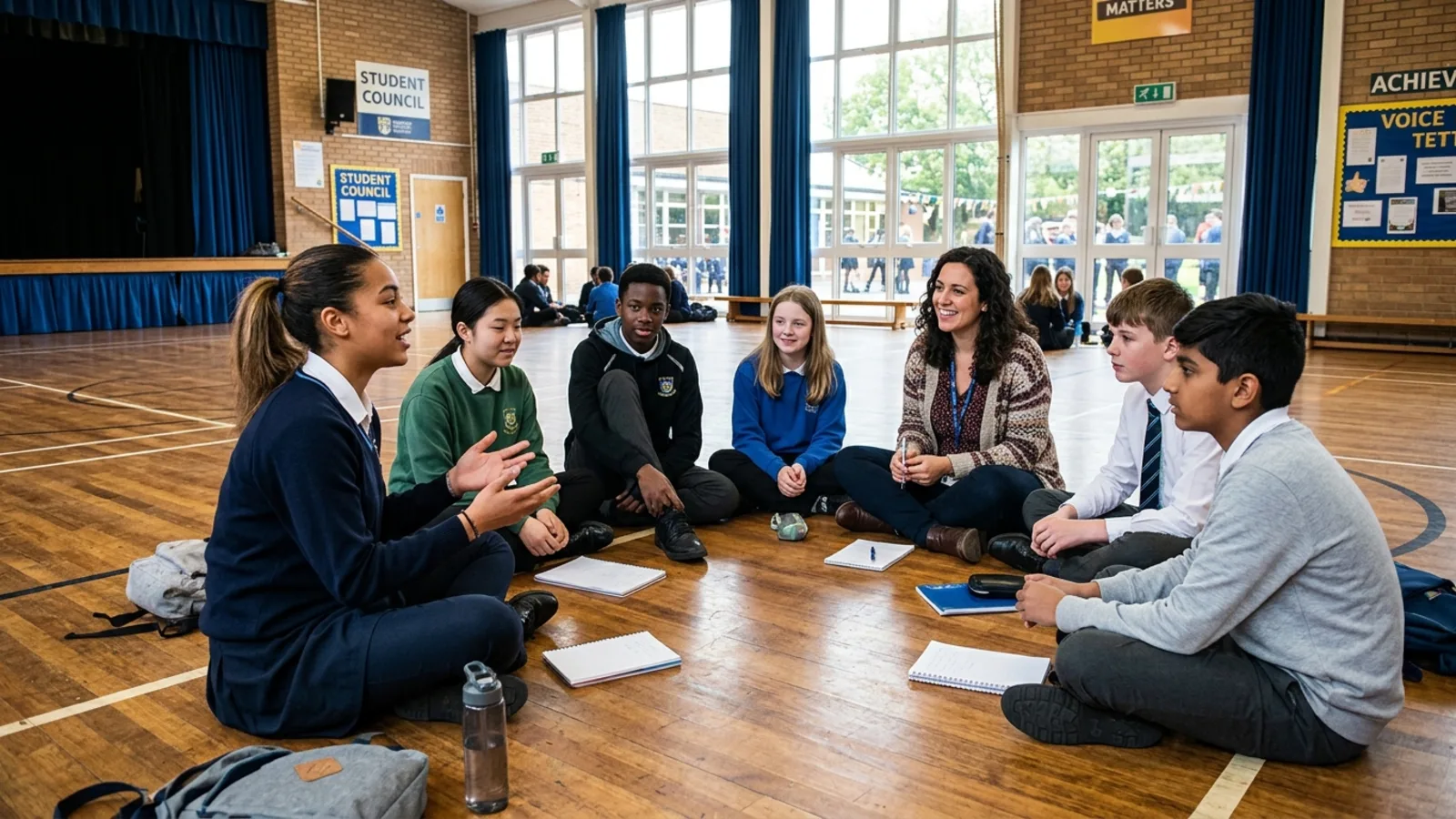
I work with a lot of students who, on paper, are fine. They are attending school, they are not in crisis, and no safeguarding concern has been raised. But their teachers and parents know something is off. They have lost their spark. They are drifting through lessons without any real sense of direction. They are quietly anxious about the future or struggling to find their place in their peer group. These students rarely reach the threshold for clinical referral, yet the standard school support system has little designed specifically for them.
Student wellbeing coaching in UK schools addresses exactly this gap. As a John Maxwell certified coach with over ten years of experience working with teens and schools across Birmingham, and having spoken about this work on Connections Radio, IE Today Magazine, and The Sylbourne TV show, I want to explain clearly what coaching is, what it is not, and why it matters for schools right now.
Making coaching part of a school’s support system
A useful starting point is to map what pupils can already access. Who handles everyday pastoral concerns? Who is the designated safeguarding lead? What happens when a pupil needs clinical support? Coaching should fit into those routes, with staff and pupils clear about its purpose.
The Department for Education’s whole-school wellbeing guidance brings together resources for schools and colleges in England. A coaching programme should sit within that wider approach rather than becoming a separate support system that staff cannot see.
Before a first session, agree:
- The practical goals pupils want to work towards, and how they will be involved in setting them.
- Who pupils can speak to between sessions and how concerns will be passed to the appropriate member of staff.
- What information is shared with the school, what remains private, and the limits of confidentiality.
- When pupils and staff will review whether the programme is useful, including what happens if another form of support is needed.
Keep the review proportionate. A pupil’s account of trying a new learning habit can be useful evidence of progress, but it should not be presented as proof of a clinical improvement. For an initial conversation about how this could work in your setting, see school coaching or contact Olive.
The Student Wellbeing Landscape in UK Schools
Most schools offer a familiar set of wellbeing provisions. PSHE lessons address health, relationships, and life skills at a curriculum level. Form tutors and heads of year provide pastoral support, monitoring attendance and behaviour and flagging concerns. Where funding allows, a school counsellor is available for students who need a confidential space to talk through difficulties. For more serious mental health presentations, schools follow the CAMHS referral pathway.
This is a reasonable framework, but it has a well-documented gap. CAMHS waiting lists are long, and referrals are typically reserved for students with clinical-level presentations. School counselling, where it exists, is demand-led and often time-limited. Pastoral care, however caring and diligent the staff involved, is ultimately a school-managed process: it is tied to the student’s academic record, attendance data, and progress reports.
That leaves a substantial population of students who do not meet the threshold for clinical support, but who are clearly not flourishing. They may be anxious about the transition to secondary school, confused about what they want after A-levels, or quietly losing confidence in social situations. For these students, coaching offers something the existing system cannot.
What Coaching Offers That Pastoral Care Does Not
The difference between coaching and pastoral support is not simply about who delivers it. It is about the structure and purpose of the relationship itself.
Coaching is student-led. In a pastoral meeting, the agenda is largely set by the school: attendance, behaviour, academic progress, or a specific concern that has been raised. In a coaching session, the student decides what to work on. This shift in ownership changes what students are willing to share and how honestly they engage.
Coaching is forward-focused. It does not process past difficulties or explore the roots of a student’s current struggles. It starts from where the student is now and works toward where they want to be. This is not about avoiding difficult conversations; it is about channelling the student’s energy toward what they can influence.
Coaching is confidential within the bounds of the safeguarding framework. Students know that what they say in a session is not fed back to their form tutor or written into their school record. This confidentiality is carefully structured: I operate within a clear safeguarding framework and hold an enhanced DBS check, so there are defined and transparent boundaries around what I would ever need to disclose. Within those boundaries, students can speak freely in a way that is genuinely difficult in a pastoral setting.
Coaching also introduces structured accountability. Students leave each session with commitments they have chosen themselves. That self-selected accountability is far more powerful than any external expectation a teacher can set.
What Student Wellbeing Coaching Addresses
In practice, most of the students I work with present in one of four situations.
Transition anxiety. Moving from primary to secondary school, navigating the pressure of Year 11 GCSEs, or standing at the post-16 crossroads are all periods of genuine uncertainty. Coaching gives students a structured space to name what they are worried about, to build a clearer picture of what they want, and to develop the confidence to move forward rather than freeze.
Confidence and self-belief. This is one of the most common issues I see, particularly in girls at Key Stage 4. The student who doubts every answer before she raises her hand. The student who has been told he is capable but cannot make himself believe it. Coaching does not offer reassurance; it works with the student to examine the evidence, challenge unhelpful thinking patterns, and build a more grounded sense of who they are.
Direction and purpose. Year 12 and 13 students in particular often describe feeling paralysed by choice. They do not know what they want, and that uncertainty makes every decision feel enormous. Coaching helps them get clear on their values, their strengths, and what genuinely matters to them, before they commit to a path.
Social confidence and peer dynamics. Not clinical social anxiety, which is a matter for a clinical professional, but the more common experience of feeling awkward in group settings, struggling to maintain friendships during difficult periods, or not knowing how to navigate conflict constructively. Coaching builds the self-awareness and communication skills that underpin healthy peer relationships.
Coaching and CAMHS: Two Different Things
I want to be direct about this, because clarity matters: coaching is not a substitute for clinical mental health support. If a student needs CAMHS, they need CAMHS.
Coaching is appropriate for students who have been assessed and do not meet the clinical threshold, and for students who are waiting for an appointment and would benefit from forward-focused, non-clinical support in the meantime. It is also appropriate for students who are managing their wellbeing without any clinical input but need structured developmental support.
What coaching does not do is diagnose, treat, or manage mental health conditions. I am not a therapist, and I do not work in that way. I hold an enhanced DBS certificate, I operate within a clear safeguarding framework, and I know when a student discloses something that needs to go to the designated safeguarding lead. That line is always maintained.
Understanding this distinction allows schools to use coaching as a genuine complement to their wider provision, rather than as a workaround for underfunded clinical services. You can find out more about what clinical mental health support looks like through the NHS CAMHS pages.
Measuring Outcomes in School Settings
Schools are accountable, and rightly so. When they bring in external support, they need to be confident that something is actually changing.
What I track within coaching is progress against the goals the student set at the outset. These goals are agreed at the first session and reviewed at every subsequent one. At the end of a programme, I provide a summary that shows movement against those goals without disclosing the content of the sessions themselves. This keeps the student’s confidentiality intact while giving the school meaningful evidence.
The changes that become visible to teachers and parents typically follow a recognisable pattern: improved self-assurance in classroom contributions, a clearer sense of post-school direction, more settled behaviour in social settings, and a student who seems more present and engaged. These are not abstract wellbeing scores; they are observable shifts in how a young person shows up.
Frequently Asked Questions
At what age is coaching appropriate for students?
I work with students from Year 8 upwards, broadly ages 12 to 18. The lower end of that range requires a different conversation style (more concrete, more structured, with simpler goal-setting) but the fundamentals of coaching apply at any secondary age. The upper end of the range, sixth formers navigating university applications and post-18 choices, often benefits enormously from the clarity coaching provides at precisely the moment they feel most overwhelmed by decision-making.
How long does a student wellbeing coaching programme take?
Most programmes run for six to ten sessions, typically delivered weekly or fortnightly over one or two terms. A student working on a specific transition or confidence challenge might see meaningful movement within six sessions. A student with more complex or longer-standing patterns of avoidance or self-doubt may benefit from a full term of regular work. I review progress with each student at every session and I provide a summary for the school at the end of the programme.
How does coaching protect student confidentiality?
Sessions are confidential within the bounds of the school’s safeguarding framework. I do not feed session content back to form tutors, pastoral staff, or parents as a matter of course. The progress reports I provide at the end of each student’s programme cover observable themes and goal progress without disclosing what the student said in sessions. The only exception is a safeguarding disclosure that requires action under school policy, which I make explicit to students before their first session.
How to Bring Coaching Into Your School
If you are a pastoral lead, SENCO, head of year, or school leader and you can see students in your setting who would benefit from this kind of support, I would welcome a conversation.
As a life coach in Birmingham, I work with schools across the region to deliver structured coaching programmes designed specifically for secondary-age students. You can read more about how I work with educational settings on the schools page and find detail about the structure of those engagements in my piece on school coaching programmes.
For parents who are wondering whether coaching might help their teenager, teen life coaching explains what one-to-one coaching with a young person looks like in practice. If you have questions about how coaching differs from counselling or therapy, I have written about that in more detail in my post on life coaching vs therapy.
To start a conversation about bringing coaching into your school, please get in touch, call me on 07505 784546, or email info@ovpcoaching.co.uk. There is no obligation; it begins with a straightforward conversation about what your students need.